
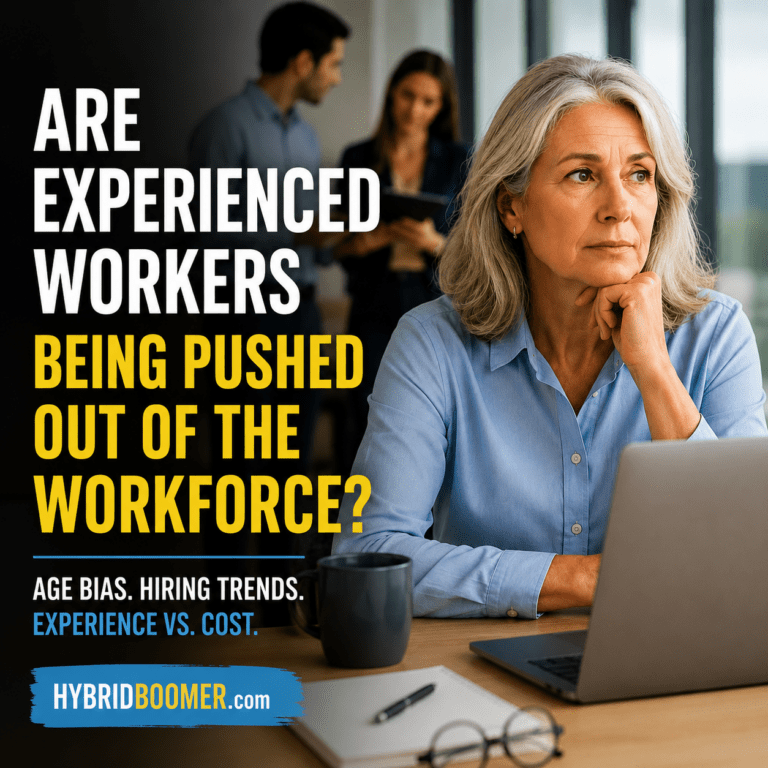
Why seasoned professionals feel invisible in today’s job market
For decades, experience was considered one of the most valuable assets an employee could bring to the workplace. Wisdom. Stability. Leadership. Institutional knowledge. The ability to solve problems because you have seen problems before. But today, seasoned professionals are asking an uncomfortable question, are experienced workers being pushed out of the workforce?
It is a controversial question. The companies say absolutely not. But employees believe age discrimination has become the workplace issue no one will openly discuss.
Yet, if you spend time talking to professionals over 50, a pattern does begin to emerge.
Older workers are applying for hundreds of jobs and too often they hear nothing back. In other cases, candidates are told they are “overqualified.” As a result, years of expertise can suddenly feel less valuable than lower salary expectations or younger candidates with fewer years of experience.
So what is really happening?
The Silent Reality of Age Bias
Let’s start with something uncomfortable, age bias exists. Not always openly and rarely admitted, but often quietly present. In fact, according to research from AARP, 64% of workers age 50-plus say they have seen or experienced age discrimination in the workplace, reinforcing what many older professionals already suspect.
No hiring manager is likely to say:
“We want someone younger.”
Instead, it may sound like:
- “We’re looking for someone with fresh energy.”
- “We want someone who fits our culture.”
- “You may be overqualified.”
- “We need someone who can grow with the organization.”
Sometimes those concerns are legitimate.
But sometimes, they raise an important question:
Are companies filtering out experience without saying so directly?
For many Hybrid Boomers, those balancing decades of work experience while adapting to today’s fast-changing workplace, it can feel like the rules changed overnight.
Experience once opened doors.
Now, it quietly closes them.
Experience vs. Cost: The Unspoken Business Decision
Let’s talk honestly about what we suspect but few openly discuss.
One difficult reality is that experienced workers often cost more. For employers, that may mean higher salaries, stronger benefits, additional vacation time, and retirement contributions. However, reducing talent decisions to cost alone can overlook long-term value.
In uncertain economic times, companies have been known to quietly prioritize affordability over expertise.
Younger workers may be viewed as less expensive, easier to train, more adaptable to new systems, and less likely to challenge workplace norms.
The irony is that organizations often underestimate what experienced professionals bring to the table.
Seasoned workers bring valuable strengths that organizations may overlook. Years of experience can lead to better judgment during times of crisis, stronger communication skills, and a natural ability to lead without needing a formal title. In addition, seasoned professionals frequently demonstrate emotional intelligence and institutional knowledge that can help companies avoid costly mistakes and navigate challenges more effectively.
In some industries, replacing experience with lower cost can create hidden consequences. When experienced employees leave, mentorship disappears.
Knowledge walks out the door.
And organizations sometimes realize too late that replacing wisdom is harder than replacing labor.
Hiring Trends Are Changing, But Not Always Fairly
The modern hiring process has also changed dramatically. Today, algorithms often decide who gets seen. Resumes are filtered through Applicant Tracking Systems (ATS) before a human ever reviews them.
Long career histories can sometimes work against applicants.
Too much experience may trigger assumptions like higher salary expectations, resistance to change, technology gaps, and shorter remaining career timelines.
Although those assumptions are common, they are not always fair, or legal. The U.S. Equal Employment Opportunity Commission (EEOC) notes that the Age Discrimination in Employment Act (ADEA) protects workers age 40 and older from workplace discrimination based on age, including hiring practices.
But are those assumptions even fair?
One might argue that workers over 50 are more technologically capable than stereotypes suggest. Our article, “Hybrid Work for Baby Boomers: What’s Working and What’s Not,” explores how experienced workers continue evolving with changing expectations. They have adapted through decades of workplace transformation:
From fax machines to Zoom, paper files to cloud computing, and office cubicles to hybrid work, Hybrid Boomers, especially, have learned something powerful:
Adaptability is not owned by youth, instead it is earned through reinvention.
The “Overqualified” Problem
Few workplace words frustrate experienced professionals more than this one:
Overqualified.
While employers rarely say this directly, concerns about age in hiring remain widespread. AARP research found that 90% of workers age 50-plus believe age discrimination against older workers is common in today’s workplace.
On the surface, it sounds flattering.
But older workers hear something different, “You’re too experienced and probably too expensive.”
The truth is, experienced workers are not necessarily chasing titles anymore. Instead, they want flexibility, meaningful work, hybrid schedules, lower stress, and purpose over prestige.
Yet hiring systems often struggle to recognize this shift.
Companies assume senior professionals will leave quickly or demand executive level compensation when, in reality, a lot of them are simply looking for a place to contribute.
Are Older Workers Really Less Valuable?
Absolutely not.
But value is being measured differently.
In many cases, today’s workplace rewards different qualities than it once did. For example, organizations may prioritize speed over patience, digital fluency over lived expertise, or cost efficiency over long-term wisdom. Nevertheless, those priorities do not automatically make experience less valuable.
That does not mean experience no longer matters.
It means experienced workers may need to position themselves differently. Highlight adaptability by showing comfort with technology. Additionally, emphasize mentorship and problem-solving. Lead with outcomes, not years.
In other words, the challenge is not whether experienced workers still matter, it is whether the workplace has remembered why they matter.
What Hybrid Boomers Understand Better Than Most
If there is one thing Hybrid Boomers know, it is reinvention.
This generation has survived economic downturns, technology revolutions, corporate restructures, and changing workplace expectations. Over time, Hybrid Boomers have learned how to pivot when circumstances change. More importantly, they have adapted, continued leading, and found ways to move forward despite constant workplace shifts.
The truth? Experienced professionals are not outdated, they are simply underestimated.
Final Thought – A Workforce Question Worth Asking
Here is the bigger question society should be asking:
Can businesses afford to overlook experience?
At a time when mentorship, stability, and leadership matter more than ever, dismissing seasoned talent may come with a cost organizations have yet to fully understand.
Interestingly, workforce participation among older adults continues to grow, suggesting some experienced professionals still want to contribute if given the opportunity.
Maybe the issue is not that experienced workers no longer fit the workplace.
Maybe the workplace is still learning how to value experience in a changing world.
For a deeper look at the ongoing value seasoned professionals bring to organizations, read “Why Experienced Workers Still Matter.”
What do you think?
Are experienced workers being pushed out, or is the workforce simply evolving?
Sources & Research
- AARP Workplace Age Discrimination Research
- U.S. Equal Employment Opportunity Commission (EEOC) – Age Discrimination in Employment Act (ADEA)
- Investopedia – Workers Want to Work Past 65
Show your pride in being a Hybrid Boomer – visit our online store.
Oh, and don’t forget to bookmark this site to come back often!
